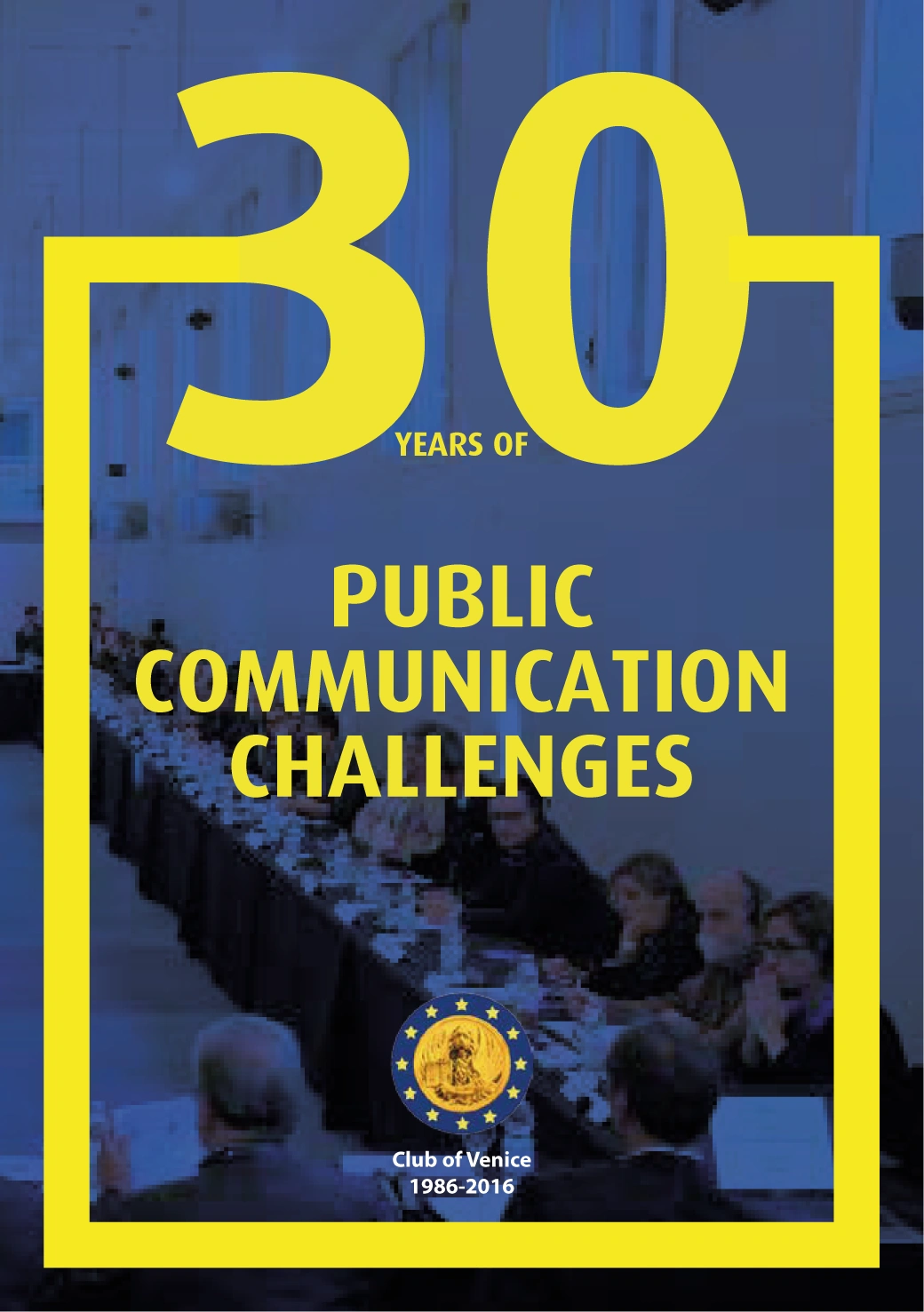
30th anniversary
This special commemorative volume marks three decades of the Club of Venice, tracing its evolution from a visionary informal network into a vital pillar of European institutional dialogue. It provides a profound analysis of how the digital revolution and the “age of proximity” have fundamentally transformed the relationship between governments and their citizens. The publication explores strategic responses to critical modern crises—including migration, terrorism, and the rise of populism—emphasizing the need for authentic dialogue over traditional propaganda. By highlighting the professionalization of the field, it advocates for high ethical standards as the cornerstone of institutional credibility and trust. Finally, it outlines a vision for a future where public communication serves as a strategic lever for democratic engagement and societal resilience.
Key Topics:
- The 30-Year Legacy of the Club of Venice: Reflecting on the history, informal spirit, and cooperation of Europe’s senior communication directors.
- Professionalizing Public Communication: Transitioning communication from a “back-room service” to a core strategic function of government.
- Ethics vs. Populism and Propaganda: Reinventing the communicator’s role to provide a public service for the common good in a post-truth era.
- Managing the Migration Crisis: Strategic inter-institutional cooperation to handle the communicative and humanitarian complexities of the refugee crisis.
- The Shift to Social Platforms: Navigating the decline of traditional mass media and the rise of conversational, visual storytelling on digital platforms.
- Rebuilding Public Trust: Utilizing the “Social License to Operate” framework to regain credibility with a disillusioned public.
- Public Diplomacy and Nation Branding: Leveraging “soft power” and shared values to project a united and attractive European identity.
- Strategic Crisis Communication: Implementing rigorous work processes and “trust hierarchies” to manage fear during terrorism or economic crises.
- Participatory Democracy and Open Data: Innovations in engaging citizens through national conventions, MOOCs, and transparent data sharing.
- The Education Dimension: Communicating European values to the “Erasmus Generation” through school programs like “Back to School”.